


Highfield Hall: From Forgotten Mansion to Falmouth’s Crown Jewel

Highfield Hall: From Forgotten Mansion to Falmouth’s Crown Jewel
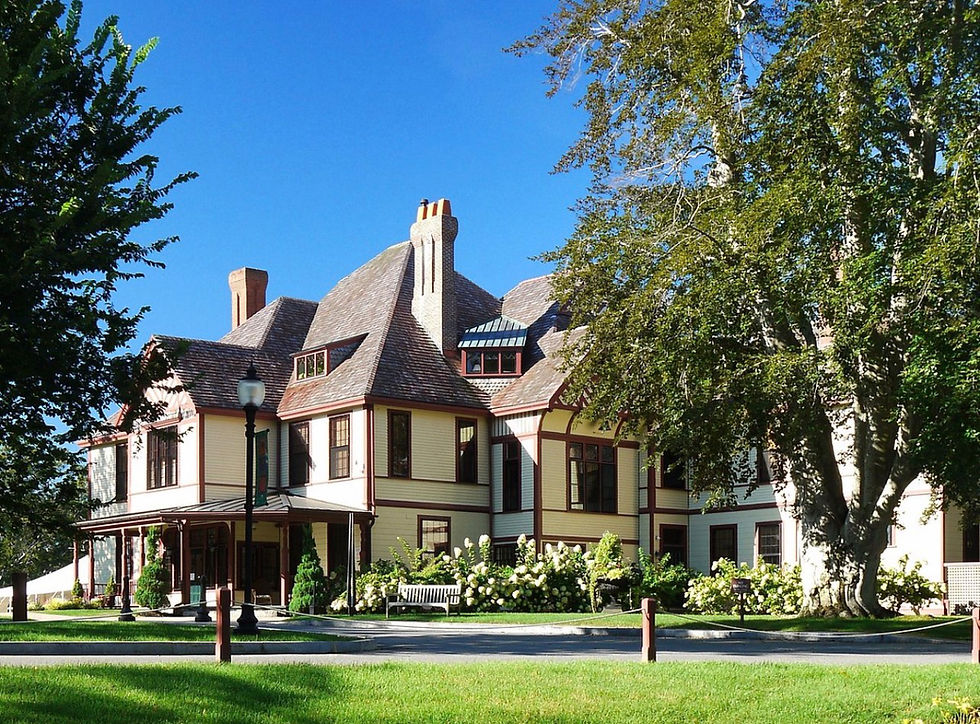
By 2001, the magnificent 1878 Stick Style mansion known as Highfield Hall had been abandoned for decades. Nature had nearly reclaimed it. Boarded windows, sagging shingles, and vines creeping over its walls transformed one of Falmouth’s grandest homes into one of Cape Cod’s eeriest landmarks.

I remember driving up to it and thinking what an incredible bed and breakfast or resort it would make.
The location was perfect. High on a hill overlooking Falmouth Village, and hundreds of acres that touched the ocean, it had everything an innkeeper could hope for. The views were spectacular, the grounds were expansive, and the mansion itself had a presence that immediately captured your imagination.
Then reality set in.
It wasn’t simply an old house in need of repairs. There was the carriage house, the barn, acres of neglected grounds, and decades of deterioration. Restoring the property would have required an investment far beyond anything I could have imagined. As much as I loved the idea, I knew I had to walk away.
Looking back, it was the right decision. Saving Highfield Hall would eventually require more than $16 million, thousands of volunteer hours, donated professional services, and nearly fifteen years before the restored estate became financially sustainable.
Standing in front of the beautifully restored mansion today, it’s difficult to imagine just how close Falmouth came to losing it forever. Its rescue was truly a love story between the town of Falmouth and the Beebe estate. But to understand why an entire community refused to let Highfield Hall disappear, you have to go back more than 150 years.
The Beginning of a Legacy
The story begins with a young man named James Madison Beebe.
Unlike many of Boston’s wealthy industrialists, James Beebe wasn’t born into privilege. Raised on a farm in western Massachusetts, he left home in the 1820s looking for opportunity in Boston. He found work in the city’s growing dry goods business and quickly proved himself to be a gifted businessman.
Through determination, sound investments, and eventually manufacturing interests, Beebe accumulated a considerable fortune. By middle age he had become one of Boston’s successful merchants, allowing him to retire years earlier than most men of his generation. Like many wealthy Bostonians during the Victorian era, Beebe searched for a place where his family could escape the oppressive summer heat of the city. He found it in Falmouth. And in 1872, James Beebe started by purchasing the Thomas Swift House on Shore Street, and converting it into a summer residence known as Vineyard Lodge. Captivated by the beauty of Falmouth, he began acquiring hundreds of acres stretching across the hills overlooking the village.
Keep in mind that long before James Madison Beebe assembled his 700-acre estate in the 1870s, these wooded hills and ponds formed part of the ancestral homeland of the Wampanoag people. The ridges, freshwater ponds, and forests that visitors enjoy today would have been familiar landscapes to Native families for thousands of years before Highfield Hall ever stood on the hill. The unique landscape is 18,000 years old. There is also a deep kettle pond in Beebe Woods called The Punch Bowl. Throughout New England, deep kettle ponds often have archaeological significance because they were dependable freshwater sources, further solidifying the importance of this landscape to our ancient Native peoples. Currently no recorded geological survey has been done to determine if burials were on this site, nor do any recorded surveys document any native artifacts being found…simply because they have never been formally done by any anthropology.
Eventually the family owned more than 700 acres, including nearly 400 acres that today are preserved as Beebe Woods.
A Family Builds Its Dream

Sadly, James Beebe enjoyed his Cape Cod retreat for only three summers before dying in 1875.
Although he never lived to see his dream fully realized, his seven children embraced Falmouth with the same enthusiasm their father had shown. Two of his sons would forever change the landscape of the town.
In 1878, E. Pierson Beebe selected one of the highest points on the estate and began construction of Highfield Hall. Rather than building an ordinary summer cottage, Pierson created one of Cape Cod’s most architecturally significant homes. Highfield Hall reflected the latest architectural trends of the late nineteenth century. Built in the rare Stick Style, the mansion blended decorative woodwork with emerging Queen Anne influences. Wide verandas captured cooling summer breezes from Vineyard Sound while enormous windows filled the home with light. Inside, soaring ceilings, elaborate woodwork, and an impressive central hall reflected the confidence and prosperity of America’s Gilded Age.
Even today, architectural historians consider Highfield Hall one of the finest surviving examples of its kind on Cape Cod.
Yet Highfield Hall was never intended to stand alone.
The Arrival of Tanglewood

Only a year later, Pierson’s younger brother, J. Arthur Beebe, began building a second mansion nearby. He called it Tanglewood. Although the two homes stood only a short distance apart, they reflected different personalities. While Highfield Hall displayed the evolving Stick Style, J. Arthur hired the prestigious Boston architectural firm Peabody & Stearns to design Tanglewood. The nationally recognized architects had already established reputations for designing some of New England’s grandest homes, including many of Newport’s famous summer “cottages.”
The result was another magnificent mansion overlooking Falmouth, incorporating Queen Anne, Shingle Style, and Colonial Revival influences.
Together, Highfield Hall and Tanglewood formed one of the most remarkable private estates on Cape Cod.
The two mansions were connected by carriage roads winding through forests and open meadows. There were barns, greenhouses, stables, formal gardens, orchards, and miles of woodland trails. Today, thousands of people walk those same trails through Beebe Woods, often unaware they were originally laid out by members of the Beebe family nearly 150 years ago.
Life on the Estate
The Beebes didn’t simply vacation in Falmouth.
They became part of it.
Unlike many wealthy summer residents who remained isolated on their estates, the Beebes developed a genuine affection for the town and its people.
Emily Beebe became one of Falmouth’s earliest socialites, entertaining guests at Highfield Hall during the summer before returning to the family’s elegant home on Commonwealth Avenue in Boston each winter. Friends gathered for elaborate dinners, music, and garden parties overlooking the village.
Her younger brother Frank had little interest in formal entertaining.
Instead, he devoted much of his time to improving the landscape itself, planting trees and shrubs throughout the estate. Those plantings helped shape the appearance of the property for generations.
The siblings spent countless hours exploring the woods, riding horseback through the trails, maintaining carriage roads, and even helping construct the stone walls that still wind through portions of Beebe Woods today.
J. Arthur’s home, Tanglewood, had a different atmosphere.
While Highfield Hall was occupied primarily by adult siblings, Tanglewood echoed with the laughter of children.
J. Arthur and his wife Emily raised three children there—Arthur, Emily, and Charles Philip. Summer evenings often included theatrical performances, musicales, charitable fundraisers, and gatherings with friends from Boston’s social circles.
Both J. Arthur and his wife were devoted animal lovers and generous supporters of organizations dedicated to animal welfare.
For decades, the Beebe estate represented everything the family had hoped it would become.
It was a place of beauty.
A place of family.
A place of extraordinary success.
No one could have imagined how quickly that story would begin to change.
Tragedy Comes to Highfield and Tanglewood
For nearly three decades, the Beebe estate represented everything James Madison Beebe had hoped it would become.
Highfield Hall and Tanglewood stood side by side overlooking Falmouth. The family divided its time between Boston and Cape Cod, escaping the city’s summer heat for days filled with horseback riding, carriage rides through the woods, sailing on Vineyard Sound, elegant dinners, musicales, and evenings entertaining friends from Boston’s Back Bay.
Emily Beebe became known for hosting lavish summer gatherings at Highfield Hall, while J. Arthur and his wife, Emily, frequently opened Tanglewood for theatrical performances and charitable events. Their youngest brother, Frank, devoted himself to improving the estate, planting trees and shrubs that enhanced the property’s already remarkable beauty.
The Beebe children weren’t simply wealthy summer residents.
They became part of Falmouth itself.
They donated generously to local causes. Several members of the family contributed funds toward the construction of St. Barnabas Episcopal Church, while Mary Louisa Beebe donated the trees that still grace Falmouth’s Village Green. The woods they cherished eventually became the public preserve now known as Beebe Woods.
From the outside, the family appeared to have everything.
Then tragedy struck.
⸻
Arthur Beebe
The first devastating blow came in 1900.
J. Arthur’s oldest son, Arthur Beebe, appeared to have a brilliant future ahead of him. A graduate of Harvard University and Harvard Medical School, he had successfully completed his residency at Massachusetts General Hospital and was beginning what promised to be a distinguished medical career.
He was only twenty-eight years old.
While the rest of his family vacationed in California, Arthur remained in Boston.
On September 24, 1900, he took his own life in the family’s Commonwealth Avenue home.
The newspapers covered the story extensively.
Friends struggled to understand what had happened. One classmate remembered Arthur as an accomplished sailor whose Buzzards Bay racing yacht, Nobska, had become one of the champions of its class. Others described him as intelligent, thoughtful, and devoted to medicine.
His death stunned both Boston society and the Beebe family.
It was a loss from which they would never fully recover.
⸻
More Heartbreak
The years that followed brought little peace.
J. Arthur’s wife, Emily, died in 1911 after a long illness.
Hoping to lift the spirits of his daughter Emily, who had become deeply affected by the deaths of both her mother and brother, J. Arthur took her on an extended trip through Europe.
Then fate intervened again.
Father and daughter had planned to return home aboard the RMS Titanic in 1912.
For reasons that have never been fully explained, they either changed their travel plans or missed the sailing altogether.
Their decision saved their lives.
But it would not save the family from further tragedy.
⸻
Emily’s Death
Just one year later, twenty-nine-year-old Emily Beebe checked into Boston’s Hotel Touraine after spending time in Manchester-by-the-Sea.
She complained of feeling ill and asked that the family physician be called.
Before help could arrive, she died from a self-inflicted gunshot wound.
The news devastated her father.
When J. Arthur learned what had happened, he rushed through Boston to reach the hotel.
During that desperate trip, tragedy struck yet again.
His chauffeur accidentally struck and killed a ten-year-old boy crossing the street.
Within the span of only a few years, J. Arthur had buried his son, his wife, his daughter, and now carried the burden of another family’s unimaginable loss.
Friends later wrote that although he continued to carry himself with dignity, the heartbreak never left him.
⸻
The Final Blow
On November 28, 1914, J. Arthur Beebe was dining at Boston’s Plaza Hotel.
Without warning, he suffered a fatal heart attack.
He was gone at the age of sixty-seven.
One Harvard classmate later reflected that beneath J. Arthur’s cheerful public personality was a man who had endured more personal tragedy than most people could imagine.
His words perhaps summed up the Beebe family better than anyone else:
“Under the staggering blows which Fate dealt him, he carried himself with manly courage to the end, but with a breaking heart.”
⸻
Charles Philip Beebe
The tragedies did not end there.
J. Arthur’s youngest son, Charles Philip Beebe, struggled with mental illness for much of his adult life.
Although he attended Harvard and later operated a farm in Oregon, his health deteriorated.
Following years of legal disputes over his father’s estate, Philip eventually spent more than a decade as a patient at McLean Hospital.
After his release, he returned to farming in Massachusetts, accompanied by an attendant for the remainder of his life.
By then, the vibrant Beebe family that had transformed Falmouth was slowly disappearing.
⸻
How Ghost Stories Begin
It is easy to understand why ghost stories eventually surrounded Highfield Hall.
One sister died young from cancer.
A brilliant young physician took his own life.
His mother died not long afterward.
A daughter narrowly escaped the sinking of the Titanic, only to die by suicide the following year.
A grieving father, racing to her side, became involved in a tragic accident that claimed the life of a child.
Within another year, he too was dead.
Another son spent years battling mental illness.
Whether someone believes in ghosts is a matter of personal opinion.
But after so much heartbreak touched one family, it isn’t difficult to understand why stories began to circulate.
As Highfield Hall and Tanglewood aged, local legends grew stronger.
Visitors claimed to hear footsteps in empty rooms.
Caretakers spoke of unexplained noises.
Some believed they caught glimpses of figures standing near upstairs windows long after the houses had been abandoned.
Others insisted Mary Louisa Beebe, who had loved the estate during her short life, never truly left.
No one has ever proved those stories.
Yet they survived decade after decade, becoming part of Highfield Hall’s history just as surely as its architecture or the family who built it.
As the years passed and the once-grand mansions slowly fell into decline, the stories only became easier to believe.
With Tanglewood’s decline and Highfield Hall’s abandonment, HGTV filmed a a segment in 2001 about the mansion, and behind the scenes the extraordinary community effort began that ultimately saved one mansion while the other was lost forever.
One Mansion Was Lost. The Other Was Saved.
By the middle of the twentieth century, the Beebe family era had come to an end. The magnificent summer estate that James Madison Beebe envisioned in 1872 had changed forever. The laughter of children, elegant summer parties, carriage rides through the woods, and evenings overlooking Vineyard Sound had become memories.
The two great mansions entered very different chapters.
Tanglewood’s Final Years

Unlike Highfield Hall, Tanglewood continued to find new purposes after the Beebe family left.
In 1947, Arthur Beckhard purchased the property and converted the old stable into what is now the Highfield Theatre. Two years later, his friend, DeWitt Ter Heun, acquired the estate and established a performing arts center. Highfield Hall became the family’s summer residence, while Tanglewood housed student actors, performers, and theater staff participating in summer productions.
Years later, after the Lilly family donated the property to the Cape Cod Conservatory of Music and Art, Tanglewood again adapted to changing times. The mansion became a summer dormitory for members of the College Light Opera Company, while Highfield Hall served as classrooms, studios, offices, and even housed the Encore thrift shop.
For a time, the old mansion remained useful.
But usefulness wasn’t enough.
Large nineteenth-century estates are extraordinarily expensive to maintain, and Tanglewood continued to deteriorate. Repairs became increasingly difficult to justify, and eventually there was no practical way to save the aging structure.
On May 20, 1977, Tanglewood was demolished.
Nearly a century after J. Arthur Beebe proudly completed his magnificent home, it was gone.
Today, visitors walking the grounds of Highfield Hall often have no idea that another grand mansion once stood only a short walk away.
Its disappearance serves as a reminder that even the grandest landmarks can vanish.
⸻
Highfield Hall Begins to Fade
Highfield Hall survived. But only barely.
Following the departure of the Conservatory, the mansion entered one of the darkest periods in its history. Vacant buildings rarely improve with age. Without constant maintenance, roofs begin to leak. Water finds its way inside. Paint peels. Windows break. Vines climb walls. Every New England winter leaves another scar. By the early 1990s, Highfield Hall had become exactly what many feared. A magnificent mansion slowly returning to nature. Teenagers found their way inside for late-night parties. Homeless individuals occasionally sought shelter within its walls. Broken windows allowed rain and snow to enter rooms that had once hosted elegant dinners and family celebrations. Many people simply assumed its days were numbered. Town officials seriously discussed demolition. For the second time in only twenty years, Falmouth stood on the verge of losing another Beebe mansion.
⸻
The Ghosts Return
It was during those years that Highfield Hall became one of Cape Cod’s most talked-about haunted locations. The abandoned mansion already carried decades of tragic family history. Now it had the appearance to match. Boarded windows. Overgrown shrubs. Loose shingles. Dark, empty rooms. Stories spread quickly. Some claimed to hear footsteps echoing through empty hallways. Others reported unexplained lights. Visitors spoke of strange sounds drifting through the silent mansion. Whether those stories were true hardly mattered. The legends grew with every passing year. Then, in 2001, national television arrived in Falmouth. HGTV selected Highfield Hall as one of the featured locations for its Halloween special Haunted New England. Television crews found exactly what they were looking for. The mansion didn’t require special lighting. It didn’t need movie props. It already looked like the perfect haunted house. The program explored the history of the Beebe family, including the long-standing legend surrounding Mary Louisa Beebe. Viewers across New England watched a mansion that seemed frozen in time, unaware that behind the scenes another story was already unfolding.
Not a ghost story.
A rescue story.
⸻
Saving Highfield Hall
Several years earlier, a small group of determined citizens had decided Highfield Hall deserved another chance. When plans emerged to demolish the mansion, local residents refused to accept its fate. More than 5,000 signatures were collected urging the town to preserve the historic building. The newly formed Friends of Highfield began what would become one of the most ambitious historic preservation efforts on Cape Cod. The challenge was enormous. Every room needed attention.
Structural repairs.
Roof replacement.
Electrical systems.
Heating.
Plumbing.
Windows.
Woodwork.
Gardens.
Virtually every inch of the property demanded restoration. No single person could accomplish it.
Instead, an entire community stepped forward. Architects donated their professional expertise.
Carpenters volunteered their skills. Electricians, painters, masons, gardeners, preservation specialists, and countless volunteers gave thousands of hours to the project. Fundraisers worked tirelessly. Donors believed the mansion deserved to survive. Little by little, year after year, Highfield Hall began to reappear. The project eventually exceeded $16 million and required nearly fifteen years before the organization became financially sustainable. Looking at the mansion today, it’s easy to admire the finished product. It’s much harder to imagine the decades of determination required to reach that point.
⸻
Highfield Hall Today
Today, Highfield Hall stands for something entirely different than it did twenty-five years ago.
Visitors no longer come because of boarded windows or ghost stories. They come because it has become one of Cape Cod’s premier cultural destinations. Throughout the year, Highfield Hall hosts art exhibitions, concerts, lectures, educational programs, seasonal festivals, garden tours, community gatherings, and some of the region’s most elegant weddings and private events.
Thousands of people walk through its front doors each year, often unaware of how close the mansion came to disappearing forever. Every restored room tells two stories. One belongs to the Beebe family, whose vision helped shape Falmouth during the late nineteenth century. The other belongs to the thousands of volunteers, craftsmen, donors, and preservationists who refused to let that history be lost. When I drive past Highfield Hall today, I still remember the abandoned mansion I once imagined turning into a bed and breakfast. I also remember why I walked away.
No individual could have saved Highfield Hall. It took an entire community. Perhaps that’s the greatest legacy of all. The Beebes gave Falmouth one of its grandest estates. More than a century later, the people of Falmouth gave it back.
⸻
Sources & Further Reading
The following sources were consulted during the research and preparation of this article:
Nilsson, Matthew. “Hours of Gold, Hours of Lead.” Cape Cod Life, April 2013. https://capecodlife.com/hours-of-gold-hours-of-lead/
Nilsson, Matthew. “Falmouth’s Legendary Highfield and Tanglewood Halls Set the Stage for the Rise—and Tragic Fall—of the Famous Beebe Family.” Cape Cod Life Publications, 2013.
Shepard, Susan. “Highfield Hall.” Spritsail: Journal of the Woods Hole Historical Museum, 2003.
Historic Highfield, Inc. History of Highfield Hall & Gardens. https://highfieldhallandgardens.org
Historic Highfield, Inc. Beebe Woods History. https://highfieldhallandgardens.org/visit-highfield/beebe-woods/
Woods Hole Historical Museum. Spritsail Archives and historical publications relating to Highfield Hall and the Beebe family. https://www.woodsholemuseum.org
Falmouth Historical Society. Historical photographs and archival materials relating to the Beebe family, Highfield Hall, and Tanglewood.
Cape Cod Times. “Network Visits Some Notable Cape Haunts for Halloween Special.” October 2001.
Massachusetts Historical Commission. Historical inventory records and architectural information for Highfield Hall.
Highfield Hall & Gardens. Architectural history, restoration history, and public programming. https://highfieldhallandgardens.org
Author’s Note: This article combines information from published historical sources, archival newspaper accounts, historical societies, and the author’s own recollections of Highfield Hall during its years of abandonment prior to restoration.
Search Words:
Highfield Hall
Highfield Hall Falmouth
Falmouth History
Cape Cod History
Historic Mansions
Beebe Family
Beebe Woods
Tanglewood
Historic Homes
Stick Style Architecture
Victorian Era
Historic Preservation
Falmouth Attractions
Things to Do in Falmouth
Cape Cod Weddings
Historic Wedding Venues
Ghost Stories
Haunted Cape Cod
HGTV
Frederick William House

Comments